
What skills and mindsets does leadership require today? To answer that question, it helps to revisit a landmark book written roughly 40 years ago: Leaders: The Strategies for Taking Charge (1985).
Translated into more than 20 languages with millions of copies sold worldwide, this book shaped not only business practice but leadership education globally.
In it, authors Warren Bennis and Burt Nanus drew a clear line between a manager and a leader:
“The manager administers; the leader innovates.”
While managers focus on maintaining people and organizations, leaders focus on innovating: refusing to settle for the status quo and boldly embracing challenges.
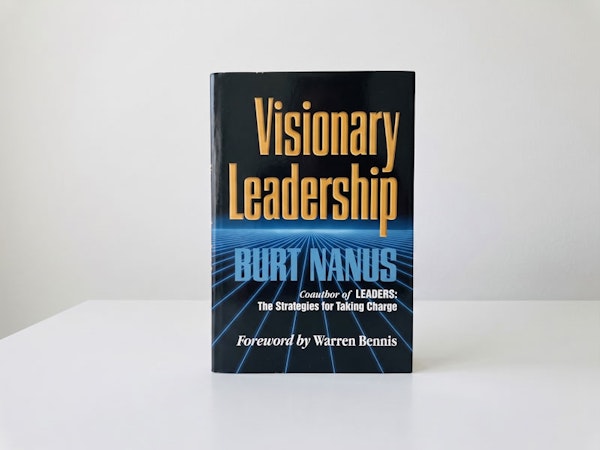
In 1992, Burt Nanus followed up with Visionary Leadership. As identified in Leaders, one of the most critical actions differentiating a leader from a manager is “articulating an attractive vision.” In Visionary Leadership, Nanus provided a concrete methodology for developing and implementing vision, establishing a definitive guide for business leaders.
Coincidentally, 1992 was also the year GLOBIS was born. Yoshito Hori, after graduating from Harvard Business School, launched GLOBIS’s very first marketing class in a small, rented classroom in Shibuya.
Driven by his vision to “create Asia’s No. 1 business school,” Hori built the institution from scratch. More than 30 years later, GLOBIS has grown into Asia’s largest business school, Japan’s premier leadership development institution, and the country’s largest venture capital fund. GLOBIS’s own trajectory demonstrates the power of vision. Yoshito Hori exemplifies the visionary leadership the institution now teaches.

In Visionary Leadership, Nanus quoted an old Chinese proverb:
“Unless you change the direction, you are likely to arrive at where you are headed.”
He urged leaders to shift their visions in response to change. Today, the pressure of that change is incomparably greater than it was 30 years ago.
With the rise of Generative AI, the reality of the technological singularity is fast approaching. As a result, markets, competitive landscapes, technology, corporate purpose, and the very role of a leader have undergone a massive transformation.
Category | 30 Years Ago (1990s) | Today (2026) |
|---|---|---|
1. Market Scope | Regional & Domestic. Constrained by geography, focused on physical trade zones. | Global & Borderless. Directly connected via digital technology, competition is global. |
2. Source of Competitive Advantage | Scale & Efficiency. Driven by mass production, mass consumption, and cost reduction. | Speed of Transformation & Experience. Driven by user experience (UX) and disruptive innovation. |
3. Technology | Analog to Digital. Emergence of PCs and the early internet as administrative tools. | Technovate*. AI, big data, and IoT form the core of business. |
4. Core Resources | Tangible Assets. Physical capital consists of people, goods, and money. | Intangible Assets. Data, AI, intellectual property (IP), networks, and trust. |
5. Corporate Purpose | Maximizing Shareholder Value. Top priorities were revenue and profit maximization. | Realizing Purpose. Creation of social value, ESG, and sustainability. |
6. Role of a Leader | Management & Supervision. Efficient command-and-control within a pyramidal hierarchy. | Vision & Kokorozashi. Providing direction and inspiring empathy in an uncertain era. |
* “Technovate” is a GLOBIS-coined term combining “Technology” and “Innovate.”
Today, every company must build a competitive edge using AI and intellectual property, while societal expectations have shifted from pure shareholder capitalism to corporate purpose. In this turbulent environment, what is expected of leaders is not “management.” It is the ability to point toward an innovative direction amid uncertainty, build deep empathy, and rally people inside and outside the organization to take action.
Returning to the pages of Visionary Leadership, Nanus characterized visionary leaders as those who:
Written more than three decades ago, these qualities remain as relevant as ever. The higher the uncertainty, the more anxious people become and the more drawn they are to a powerful, unwavering vision.
Jensen Huang, CEO of NVIDIA, shared his philosophy on vision:
“If a problem is so complex, a large vision and a large market creates a flywheel that works.”
Even an entrepreneur at the forefront of AI depends on vision as his anchor.
That vision must also stem from authentic values. When asked by Fast Company, “If you could give one piece of advice to someone stepping into their first leadership role, what would it be?” Alphabet CEO Sundar Pichai responded:
“You have to find what is truly authentic to you. You have to be yourself.”
Be yourself, and articulate a vision rooted in your genuine values. At GLOBIS, we have long asserted that a Visionary Leader requires kokorozashi.

Kokorozashi is a unique Japanese concept that can be translated as “personal mission” or “high aspiration.” The samurai who led the Meiji Restoration (a pivotal event that catalyzed Japan’s modernization) were driven by kokorozashi. Faced with a national crisis, they risked their lives to spearhead a national transformation.
Today, we live in a VUCA world where there are no textbook answers. In an age flooded with information and shifting values, kokorozashi is that compass. Those aspiring to lead in the AI era must establish a kokorozashi rooted in their own values, and project a future vision built on it. Crucially, that vision must look beyond personal gain to contribute to the greater good of society.
At GLOBIS, we redefine “Visionary Leadership” as the power exercised by leaders who rise to challenges with this kind of profound kokorozashi. In this transformative AI era, we hope that many will cultivate this renewed “Visionary Leadership” and emerge as the pioneers who lead the world forward.
The questions at the heart of this article, what vision requires, where it comes from, and how leaders sustain it, form the foundation of GLOBIS’s Visionary Leadership Program. Designed for senior professionals navigating the complexities of the AI era, the five-day immersive experience in Japan draws on GLOBIS’s decades of leadership development expertise to help participants clarify their kokorozashi and develop the conviction needed to lead through uncertainty.
Learn more about the Visionary Leadership Program
Visionary leadership is shaped not only by strategy and vision, but also by the values and philosophies that guide leaders through uncertainty.

Yosuke Inoue
Managing Director at GLOBIS & Program Director of Visionary Leadership Program
Yosuke Inoue is a Managing Director at GLOBIS, leading the Branding & Marketing Department. He is the Program Director of the Visionary Leadership Program (VLP), a new executive education program for global leaders. He has extensive experience in corporate consulting, leadership development, and new business creation, and teaches leadership, creativity, and innovation at GLOBIS University.


Every organization's needs are different. With our global learning options, we're ready to help you find the right program to achieve your talent development goals.


