
Most senior leaders already carry some form of personal mission. The problem is that corporate life buries it. GLOBIS designed a programme to dig it back out.
In the first instalment of this series, we explored why visionary leadership may become the defining capability of the AI era. As analysis becomes increasingly automated, the decisions that matter most will depend less on information and more on judgement, conviction and purpose.
At the centre of GLOBIS' approach to leadership is kokorozashi: a deeply held personal mission that guides decisions when certainty is impossible. Rather than treating purpose as an abstract ideal, the Visionary Leadership Program is designed to help experienced leaders uncover, test and articulate it.
That raises two questions. What exactly is kokorozashi? And can something so personal really be cultivated?
At the final session of the Entrepreneurial Leadership course at GLOBIS University, students present their Personal Mission Statement. Kokorozashi. GLOBIS treats it as an essential quality for any leader.
I should admit that when I joined GLOBIS eight years ago, I did not find the concept easy to absorb. As a Learning & Development consultant, I pitched the importance of kokorozashi to corporate clients multiple times a week. If I am being honest, it sometimes felt vague, perhaps even like business jargon.
The shift happened gradually, and because of what I was seeing in front of me. It happened because of people, not theory. Colleagues who had a clear kokorozashi made different kinds of decisions. Leaders from client companies who could articulate theirs led with a steadiness that was hard to explain through competency frameworks alone. The more I spoke with them, the more I noticed how their kokorozashi shaped not just what they chose to do, but how they responded when circumstances made those choices difficult.
The world is unstable, and the instability is compounding. Leaders encounter news every day that forces them to judge what is right or wrong without precedent or clear data.
At the same time, AI will increasingly support analysis and automate many tasks. The responsibility for making difficult decisions, however, still rests with leaders.
Leaders make decisions. They will not always make the best ones, but the job demands that they make better ones, repeatedly, under pressure. Doing so requires exposure to diverse perspectives, the willingness to have your assumptions challenged. It also requires something internal: a firm belief that functions as a north star, steady enough to guide you when the external signals are contradictory or absent.
That combination of open-mindedness and firm conviction is what senior leaders need.
Kokorozashi does not arrive in a flash of inspiration. It does not change often, but it does not emerge suddenly either. It requires deep, sustained thinking and continuous exposure to unfamiliar perspectives. The process takes time and intentional effort. Once crystallised, though, it becomes remarkably durable.
Finding it is not easy. In the middle of corporate commitments, quarterly targets, and operational demands, carving out space for that kind of reflection is close to impossible. It is easy to operate on autopilot for months or years and wake up one day unsure of where you are heading.
Traditional business education does not get this wrong, exactly. Programs that focus on strategy, finance and measurable outcomes also help leaders build conviction. In a stable environment, that emphasis works. But, in an era where prediction itself is unreliable, something less tangible becomes more important.
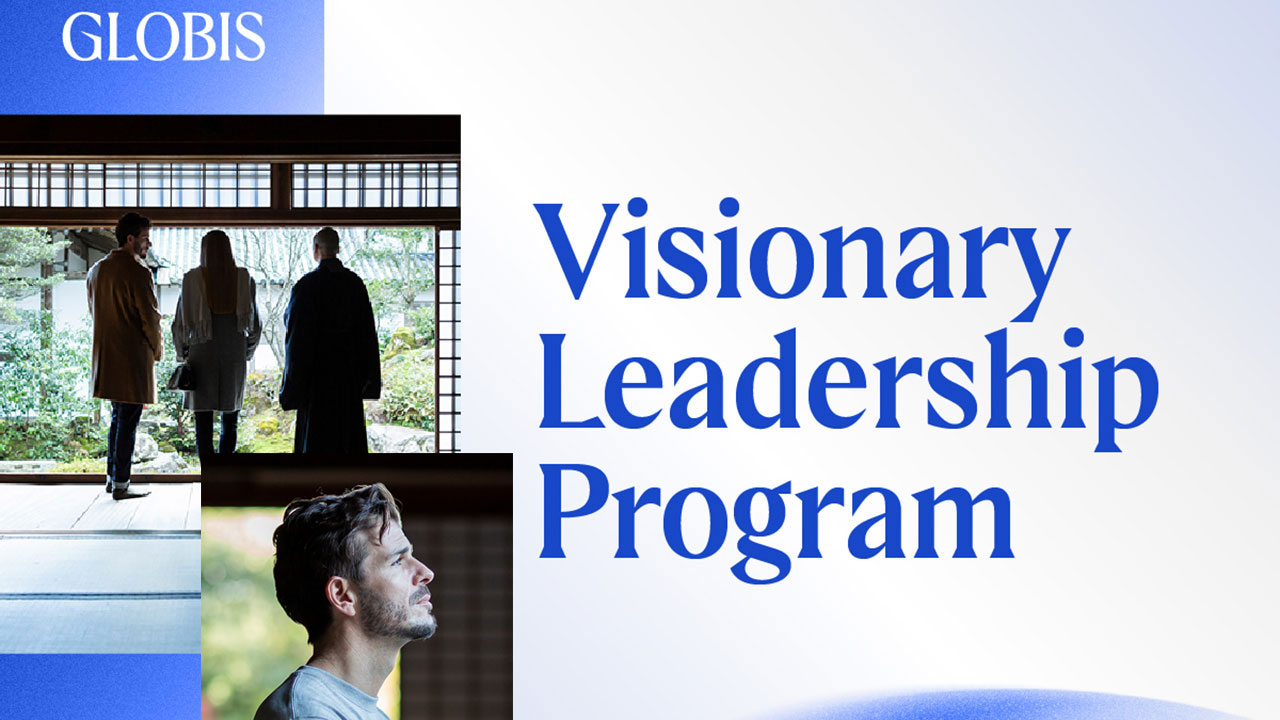
The Visionary Leadership Program (VLP) is deliberately designed as a non-linear experience. Rather than teaching participants a single framework, GLOBIS exposes senior leaders to different ideas and asks them to interpret those experiences for themselves.
Kokorozashi is introduced from the opening session and revisited throughout the program alongside Japanese concepts such as Zen, Do and Wa. Case studies and site visits explore long-term thinking, stakeholder perspectives and human-centred leadership.
At the program's conclusion, GLOBIS founder Yoshito Hori, himself an embodiment of kokorozashi-driven leadership, addresses participants before they declare their own kokorozashi and carry it forward into a structured reflection period.
First, sharper strategic decision-making through diverse perspectives. For decades, Western management practices have served as the foundation for global business leadership. VLP asks whether what leaders have long accepted as right is the only way to think about the problem. Immersion in a fundamentally different environment forces participants to question conventional wisdom, and that questioning, done well, leads to better decisions.
Second, Kokorozashi-driven leadership. Most senior leaders already carry some form of kokorozashi, but it is often dormant or inarticulate. VLP is designed to pull it to the surface, help participants verbalise it clearly, and reconfirm their long-term direction with greater precision.
Third, a lasting professional network. VLP brings together business professionals from different cultures and industries. Upon completion, participants gain access to the G1 network, a forum for sustained dialogue with senior global leaders. That ongoing connection ensures kokorozashi continues to be tested, refined, and sharpened long after the program ends.

What does kokorozashi look like when it is active in a person's leadership? The best way to answer that is through examples.
Kokorozashi takes different forms depending on the person. For Dr. Suad Al Mudhaffar, it meant dedicating her life to expanding access to education in Oman, a journey documented in Mudira: A Story from Oman and celebrated by GLOBIS as an example of purpose-driven leadership.
For Eriko Yamaguchi, it became the mission of building "a globally recognised brand from developing countries." Rather than treating business and social impact as separate pursuits, she built Motherhouse around the belief that world-class products could create economic opportunity for artisans in countries such as Bangladesh.
Another example comes from Tatsuya Mizuno, who helped drive the development of Olyset Net, an insecticide-treated mosquito net that adapted existing chemical technology into a public health innovation. Today, the nets are distributed in around 100 countries through organisations including UNICEF, illustrating how a long-term commitment to solving a societal problem can reshape the purpose of a business.

The program takes place in Japan, and the content is rooted in Japanese culture and management philosophy. But the goal is not to teach participants to lead like the Japanese. The goal is to present a fundamentally alternative way of thinking about business and leadership.
Participants are meant to feel the contrast between their existing assumptions and this unfamiliar reality, and sometimes the friction. By sitting with that tension rather than resolving it prematurely, they expand their perspective and begin making decisions from a wider vantage point.
The future will be shaped by leaders who hold a clear sense of purpose. Developing that clarity requires intentional effort, and most operating environments actively work against it.
If you are ready to surface your kokorozashi, test it against unfamiliar perspectives, and carry it forward with greater conviction, the Visionary Leadership Program is designed for exactly that.

HyunJung Cho
Manager at GLOBIS Corporation
HyunJung Cho is a Manager at GLOBIS Corporation, where she works with Japanese and multinational organisations on global talent development. Before joining GLOBIS, she began her career in banking in Korea and later worked in Japan on overseas investment and new business development for a leading education company. She currently leads the development of GLOBIS' Visionary Leadership Program, drawing on extensive experience helping organisations cultivate leadership for an increasingly complex global business environment.


Every organization's needs are different. With our global learning options, we're ready to help you find the right program to achieve your talent development goals.


.jpg&w=3840&q=75)


