
Learn to find the cultural patterns behind feedback, decisions, and silent resistance in multinational teams.
Despite a successful international career at companies like HP and GE, Chika Miyamori spent many years feeling that something wasn’t quite working. Her ideas were often well received—yet not acted upon. Feedback sounded positive, but outcomes didn’t follow.
At the time, she assumed the issue was language. Like many global professionals, she invested heavily in improving her English, believing fluency would close the gap. But the friction remained. Over time, she began to notice a pattern: the misunderstandings were not random, and they were not personal.
The breakthrough came when Miyamori encountered Geert Hofstede’s cultural framework. It gave structure to what she had been sensing all along. “It wasn’t language,” she recalls. “It was culture.” That realization reframed years of frustration—not as individual failure, but as a clash of invisible assumptions. And it fundamentally changed how she understood leadership across borders.
Today, Miyamori is a CQ (Cultural Intelligence) Expert and Leadership Coach who has worked with over 50 nationalities.
"I started this work because I don't want anyone to go through the pain, confusion, self-doubt or unnecessary investment in language lessons that I experienced. I want people to see that differences are power."
Hofstede's groundbreaking work began in the 1960s and 70s when, as an HR research manager at IBM Europe, he surveyed over 100,000 employees across multiple countries. Without computers, using only paper and pencil, he discovered something unexpected: the biggest differences came from national culture, surpassing gender or generation.
"He was one of the first people to quantify national cultural differences using scores from 0 to 100," Miyamori explains. He identified six dimensions to explain cultural differences, including how societies relate to power, individuality, uncertainty, gender, time orientation, and indulgence.
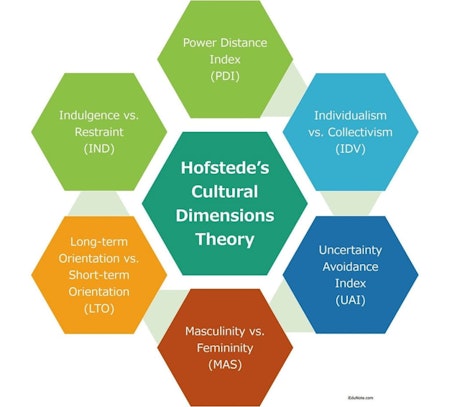
What makes the framework still relevant today, more than 50 years later? "The most important thing is the relative position of the countries," says Miyamori. "Even though we are changing toward more individualistic societies and less power distance, the distance between, for example, the Nordics and Japan remain. That's why this model is still valuable."
While Hofstede identified six cultural dimensions, Miyamori emphasizes four that have the most significant impact in workplace settings:
These cultural dimensions create misunderstandings even when everyone speaks the same language. Miyamori shares a common scenario that confuses non-Japanese executives: "When they presented something at the board or executive meeting, they were told it was a great presentation. Then when they came back to their own country, their proposal was declined and they got confused."
From a Japanese perspective, this reflects the need for internal alignment before making final decisions. "Maybe at the board meeting everybody thinks it was great. Then when they check the content with, for example, the financial department, they need to change their decision," she explains. "Meanwhile, non-Japanese executives get confused because they were told it was a great presentation—why was their idea declined?"
Similarly, Japanese teams often ask for information that others perceive as excessive. What feels like a small request in Japan, Miyamori explains, can come across very differently in the US where colleagues may think it’s simply too much information.
These are different cultural lenses interpreting the same behavior.
Miyamori recommends three priorities for leaders developing their cultural intelligence:
In diverse teams, Miyamori looks for predictability: clear meeting norms, explicit decision points, and routines people can rely on. One practical tactic is brainwriting—having people write ideas before discussion—so quieter members and non-native speakers contribute without fighting for airtime.
Consider a common scenario: a team with four Americans and two Japanese members. The Americans speak quickly and dominate the conversation. The Japanese members stay quiet, even though they have valuable input.
"When it comes to Japanese fluency in English, they have good ideas. [The challenge] is how to express them," Miyamori notes. Good leaders give their employees a way to communicate even in an asymmetric discussion.
"People who are not fluent in English or people who are not direct communicators can also think and write it on paper, and each member can share their idea. Everybody can have a vehicle to say something,” she says.
Miyamori sees cultural intelligence as the missing link in diversity, equity, and inclusion (DEI) efforts. "CQ brings DEI to life, because policies and systems alone don't automatically enable people to work effectively across differences," she argues. "CQ can fill the gap, helping individuals understand themselves, understand others, manage assumptions, and adapt their behavior in real time."
She points to how global companies like Starbucks and Google have learned to localize their approaches. "CQ can help leaders localize DEI in a way that respects each culture while still building inclusion,” she notes.
When Google rolled out its “20% time” policy in Southeast Asia and Japan, many employees were unsure how to use the freedom it offered. The solution wasn’t changing the policy itself but adapting how it was implemented — providing clearer guidance that respected higher power-distance cultures while preserving Google’s core value of innovation.
For years, Miyamori tried to solve misunderstandings as a communication problem. What experience eventually taught her was deeper and more uncomfortable: the real challenge was not how clearly she spoke, but how meaning is shaped by culture long before words are exchanged.
Today, her work is guided by a simple but demanding belief. Cultural intelligence is not about becoming someone else. It is about understanding your own lenses, recognizing those of others, and choosing—consciously—how to bridge the space between them.
Culture does not disappear in global organizations. It becomes more powerful. Leaders who learn to work with it—not around it—unlock trust, innovation, and inclusion that no language training alone can deliver.

Chika Miyamori
CQ (Cultural Intelligence) Expert and Leadership Coach


Every organization's needs are different. With our global learning options, we're ready to help you find the right program to achieve your talent development goals.


